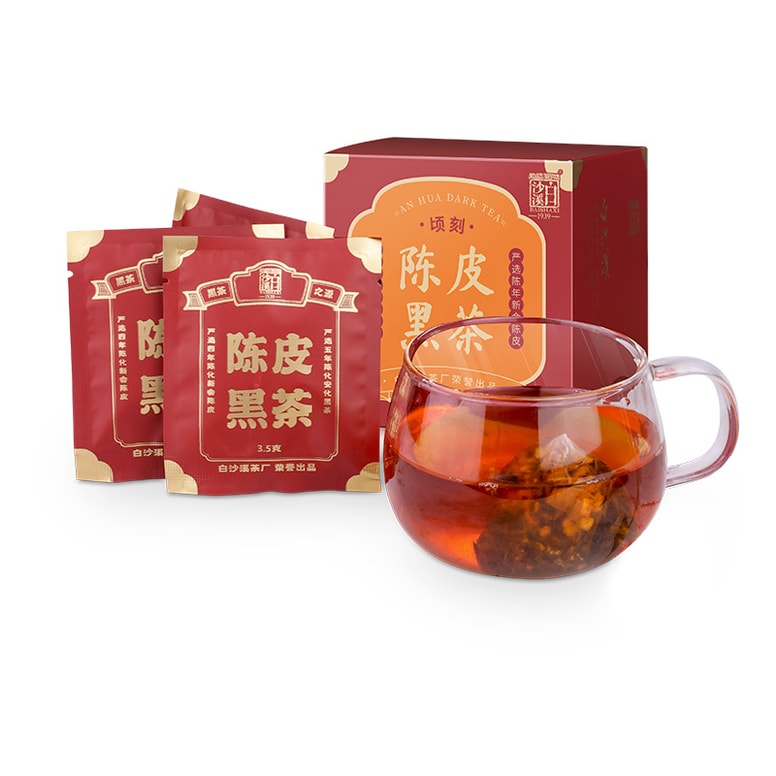
Strictly selected Anhua Grade 1 dark raw tea is used as the raw material, refined through traditional processes such as screening, fermentation, pressing, "flowering" (fungal growth), and drying.
During the production process, the semi-finished products adopt the traditional "Seven-Star Stove pine wood open flame" roasting craft, allowing the tea body to naturally form a unique pine-smoke aroma.
The shape of the tea brick is regular and uniform, with distinct edges and corners, and a dark, oily, and lustrous color.
Following the traditional natural "flowering" process, the "Golden Flowers" inside the tea brick are flourishing and evenly distributed, with a rich and distinct fungal fragrance.
The scientific name of Golden Flower is Eurotium cristatum, which is a beneficial probiotic flora, also known as the "Golden Flower Fungus."
During the flowering process, microbial metabolism and enzymatic reactions transform the tea's inclusions: the catechin content decreases, while the contents of theaflavins, thearubigins, and theabrownins increase, thereby forming the unique mellow taste and fungal-flower aroma of Fu brick tea.
The raw materials are selected from the Yuntaishan large-leaf tea trees in Anhua, featuring stout buds and leaves, soft leaf texture, and rich internal substances.
Furthermore, high-quality materials consisting of one bud and two to three leaves harvested around Grain Rain (Gu Yu) are specially selected to ensure the tea quality is full-bodied with high brewing endurance.
The dry tea has a distinct pine-smoke scent, with a pure and smooth aroma; after brewing, the liquor color is bright orange-yellow, oily, and transparent, the taste is mellow and smooth, and the fungal fragrance harmoniously blends with the pine-smoke scent, offering rich layers and a distinct sweet aftertaste.
The traditional Seven-Star Stove pine wood open flame craft endows the tea with a unique pine-smoke charm and provides a foundation for later transformation. This causes it to gradually present a more steady medicinal and aged fragrance during the aging process, possessing high value for both drinking and collection.
Brewing Methods
Easy Mug Brew
Use a 1:100 ratio (1g tea/ 100 ml water). Place tea in a mug and add 100°C (212°F) water. Steep for 5–7 minutes. Refill when one-third remains. Use boiling water to fully awaken the aged notes.
Traditional Gongfu Style
Pre-warm a gaiwan or Yixing teapot. Use a 1:30 ratio with 100°C (212°F) water. Steep for 10 seconds for the first two infusions, gradually increasing time. This highlights the evolving layers of fruit and grain.
Thermal Steeping
Use a 1:200 ratio. Pour boiling water into a ceramic-lined flask or teapot. Close the lid and steep for 1–2 hours. This slow extraction coaxes out the maximum sweetness and medicinal benefits.
Boiling Brewing
Use a 1:200 ratio. Add tea to water once it reaches an initial boil. Cook for 10–15 minutes to extract a deep, robust flavor. Strain the liquor for serving, leaving 1/3 of the tea in the pot to be refilled with hot water; this method can be repeated twice.
**Founded in 1939 in Hunan, Baishaxi 白沙溪 is a pioneer of Chinese dark tea and a guardian of Intangible Cultural Heritage. Renowned for its "King of Teas," the Qian Liang Tea, the brand seamlessly blends traditional handcraft with modern quality standards. Baishaxi remains a global benchmark for premium, aged dark tea, highly prized by collectors for its evolving flavor and historical prestige.


 Official Seller